 ocet-vis.gif
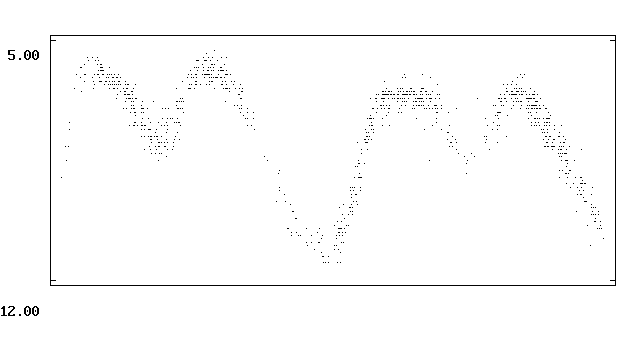
Hi Reinder and others, Visual observing has sure become complicated since I gave it up. But the results are not much different. I have appended graphs of 1000 days of each of Mira (o Cet) and R Cen. In spite of all the talk about rods, cones and whatever these still show SDs of >+/-0.3 magnitudes. Before stating that these are beginners' stars I might comment that experienced observers have contributed to much of this data and their deviations from the mean are similar to most others. The data are not good enough for a project I am working on - hence my interest in Sebastian's methods which seem to produce better results. Let's consider the eye from a p.e. UBV perspective. It's a broad band detector with sensitivity from ~400 to ~700nm. This varies from person to person. So it's subject to colour effects and extinction. Visual observers often observe at low altitudes, up to 5-10 air masses, so differential extinction can become large. The easy solution is to select sstars of similar colour to the variable - all G K and early M class stars for comparisons in the traditional cool star LPV fields. All K stars are slightly variable over time, but this is probably not a real problem. Any time early type stars are used for comparisons there will be scatter - as is clearly seen. Brian Skiff suggests one good solution which we used in preparing photographic charts at Auckland - using a yellow filter. This is a bit messy and makes the fields seem fainter, so would be strongly resisted by the traditionalists. Maybe Sebastian has found a way to avoid some of the colour problems. All this talk about rods and cones is impressive but is it important? If the scatter of visual measures is as bad as it looks then are the effects not buried in the noise? The difference between 520nm and 540 nm seems unimportant in a bandwidth of 300nm. And the sensitivity of eyes varies - as is clearly seen in comparing two persons' measures of the same star and of different stars. There is no consistency, but this may be the results of poorly measured or selected comparisons. Some areas of VS observing would benefit greatly from 0.01 quoting of measures. Longer period Cepheids, low amplitude SR stars, etc. But most of the Miras have large amplitudes and making sequences (and recording an extra digit on all measures) would create a lot of extra work. But maybe the visual VS groups may have to face up to the fact that their techniques are becoming dated. We've often tried to match visual and V data from UBV measures but find it difficult. The scatter shown in the attachments is real. Another solution would be to reject all low altitude measures, say at more than 2 air masses. This would restrict seasons but would produce better data. Surely quality comes before quality? Unfortunately most groups seem geared to judge performance by numbers - it's the easiest criterion. OK, one or two give value to fainter measures, although one wonders at the value of measuring the minima of Mira stars. But that's a different topic. A lot has been written about v, V comparsons, the general accuracy of visual measures and allied topics. But the proof lies in the resulting products. I compare these graphs of Mira and R Cen against Sebastian's measures of delta Scorpii and think - well here's a real improvement! And how many of us looked at these stars and didn't notice the variability? So let's try to improve the quality of visual measures in any way possible. Regards, Stan ----- Original Message ----- From: reinder j bouma <rjbouma@wxs.nl> To: <vsnet-chat@kusastro.kyoto-u.ac.jp> Sent: Saturday, February 03, 2001 1:46 AM Subject: [vsnet-chat 4048] RE:Visual estimates accuracy
ocet-vis.gif
 rcen-vis.gif
 VSNET Home Page
  Return to Daisaku Nogami
