[Message Prev][Message Next][Thread Prev][Thread Next][Message Index][Thread Index]
[vsnet-const 7] RE: V449 Sco
Dear Fraser, Chris, John, Jaime and all the people that answered my V449 Sco
posting:

It has become clear that this star is a MUST BE in our observing program
now. Such an amplitude as observed by John is very unlikely (if you prefer,
impossible) to be due to observational error.
But as Fraser pointed out, I must have been very unlucky or something
strange is happening with this star.
First of all I have to make clear that the original analysis belongs to one
of vsnet observers, Jaime Garc, who has already sent another set of his
observations.

The original article was published in Revista Astronica # 182/183 , 1973.
(J.Garc & G.Gallassi)
The visual observations were made by the authors and Omar Blanco and Mario
Burstein.
They support their speculation about an E type classification in the
spectral type of the star and its position in the galaxy. I agree with that.
V449 Sco is an A1IV/V star and it's very unlikely to be an intrinsec
variable, at least with such a great amplitude.
But I have to say that my observations, all of which show a 7.0 magnitude,
are all class 1 so we should start looking again and see what happens. The
star is very high in the sky now so we have a very good oportunity to find
out the true nature of V449 Sco.
There's a good amount of data now for Chris to start a period search.

The AAAA observations were as follows ( Julian Dates as in the original)

2440808.6      71
2440823.6      70
2440835.5      71
2440883.5      73
2441210.6      71
2441214.5      72
2441250.5      66
2441254.5      69
2441504.5      71
2441506.6      68
2441508.6      67
2441510.5      68
2441511.5      70
2441512.4      68
2441513.5      67
2441514.5      66
2441515.5      67
2441516.5      69
2441533.6      72
2441540.6      70

The star should be observed twice a night if possible and reported to at
least three decimal places.
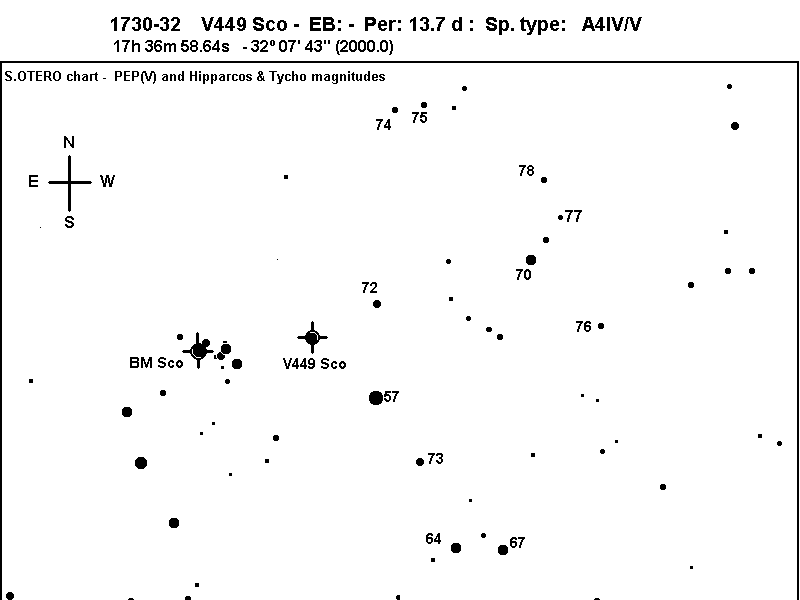
My "70" observations are below in Fraser's answer and I attached a chart for
visual observing.
The details for the sequence are:

64=  HD 158619   6.44,  1.19
67=  HD 158320   6.68,  0.08
70=  HD 158186   6.99, -0.02   Unfortunately this star is the most suitable
star regarding color and brightness but it has been discovered by Hipparcos
as a possible EA type. Most of the time is at 6.99 and falls to 7.10 with a
probable 8.77-day period. It should be used carefully.
72=  HD 159174   7.15,  1.36
73=  HD 158859   7.27,  0.13
74=  HD 159090   7.42,  0.08
75=  HD 158883   7.46,  0.96
76=  HD 157781   7.59,  0.30
77=  HD 158020   7.73,  1.30
78=  HD 158123   7.80,  0.18

Good observing!

Sebasti睹.


> G'day all,
>
> Sebastian's message illustrates the value of re-investigating stars for
> long term changes in their behaviour.
>
> My first thought after reading his observations was "maybe he was unlucky
> and kept seeing the same phases in the lightcurve?"  However a bit of
> arithmetic shows that this thought is difficult to prove.  Or disprove.
> Many thousands of cycles have elapsed since the original ephemerides were
> determined, so any small errors have accumulated...or real changes may
have
> occurred.
>
> Below are Sebastian's observations; to which I have added the supposed
> phase of the lightcurve at which they were made.  The first column assumes
> a constant period of exactly 13.7 days since epoch, the second a period of
> 13.71 days.  As usual, a phase of 0 or 1 is the primary minimum, 0.5 is
the
> secondary minimum:
>
>                                        13.7   13.71
>                                       -------------------
>     19980228.2868   70      0.86    0.37
>     19980301.2409   70      0.93    0.43
>     19980331.2090   70      0.12    0.62
>     19980409.1770   70      0.78    0.27
>     19980420.1701   70      0.58    0.07
>     19980428.2152   70      0.16    0.66
>     19980501.2013   70      0.38    0.88
>     19980505.1722   70      0.67    0.17
>     19980720.0215   70      0.20    0.70
>     19980813.1458   70      0.97    0.46
>
> This exercise can be repeated for any period near 13.7 days to produce
> almost any phase numbers you want.  Sebastian may have been unlucky after
> all !
>
> I haven't read the original article (and I probably couldn't, as I know
> zero Spanish), but I would guess that the 13.7 day period was a first
> approximation and the authors planned further observations to get a better
> value.  I can only speculate as to why this didn't happen.  We can also
> speculate about orbital changes, postulate perturbations by a third
object,
> invoke pulsations in either or both components, etc, etc.
>
> But the real answer to this mystery will (of course) come from a new
> observing campaign.  I presume Sebastian has a chart and will make it
> available?  If vsnet's storage space has been conquered by its own mail
> archives ;-) then I can place it on my server instead.
>
> And maybe the latest GCVS classification is simply the result of a lack of
> recent and/or definitive observations?  I'm reminded of all those years
> that we collectively ignored what is now V854 Cen....
>
>
> cheers,
> Fraser Farrell
>
>
V449 Sco chart.gif
vsnet-adm@kusastro.kyoto-u.ac.jp
 VSNET Home Page